Warehouse optimisation
Better decisions, sooner.
Your systems tell you what happened. Fettle reads them and tells you what matters most and next.
Fettle is decision support for the warehouse, insight before action. It isn't reporting and it isn't another set of dashboards, since a report that lands next month can't support a decision you have to make this morning.
The Fettle formula
Fettle reads the systems your warehouse already runs and shows the people who run it what needs attention today. They decide what to change. The same numbers then show whether it paid.
-
Your systems
Fettle reads what your WMS and the systems around it already record
- WMS, ERP, LMS, planning, finance and more
- Fettle goes on top
- Nothing gets replaced
-
Fettle
Reads your warehouse the way somebody who has run one would
- Your data, standardised and checked before anything reads it
- The measures that matter on the floor
- AI reads the detail, never the raw feed
-
Your people
Each manager sees the part of the warehouse they answer for
- Operational views for the GM, operations, planning and finance
- Each view opens on the question that role asks
- Configured to your warehouse within four weeks
-
Their decision
Fettle shows what matters. The manager decides what to change
- The command view shows what needs attention today
- The number and where it came from, before any detail
- The same numbers show whether the change paid
-
Measurable value
The lowest cost your warehouse can run at without breaking the promise to the customer
- Orders out on time and in full
- People used well, with the off-system work counted
- Stock and space set up to work efficiently
- Margin you can see on the work you do
The four questions Fettle answers them from your own data.
- Will we deliver today's commitments?
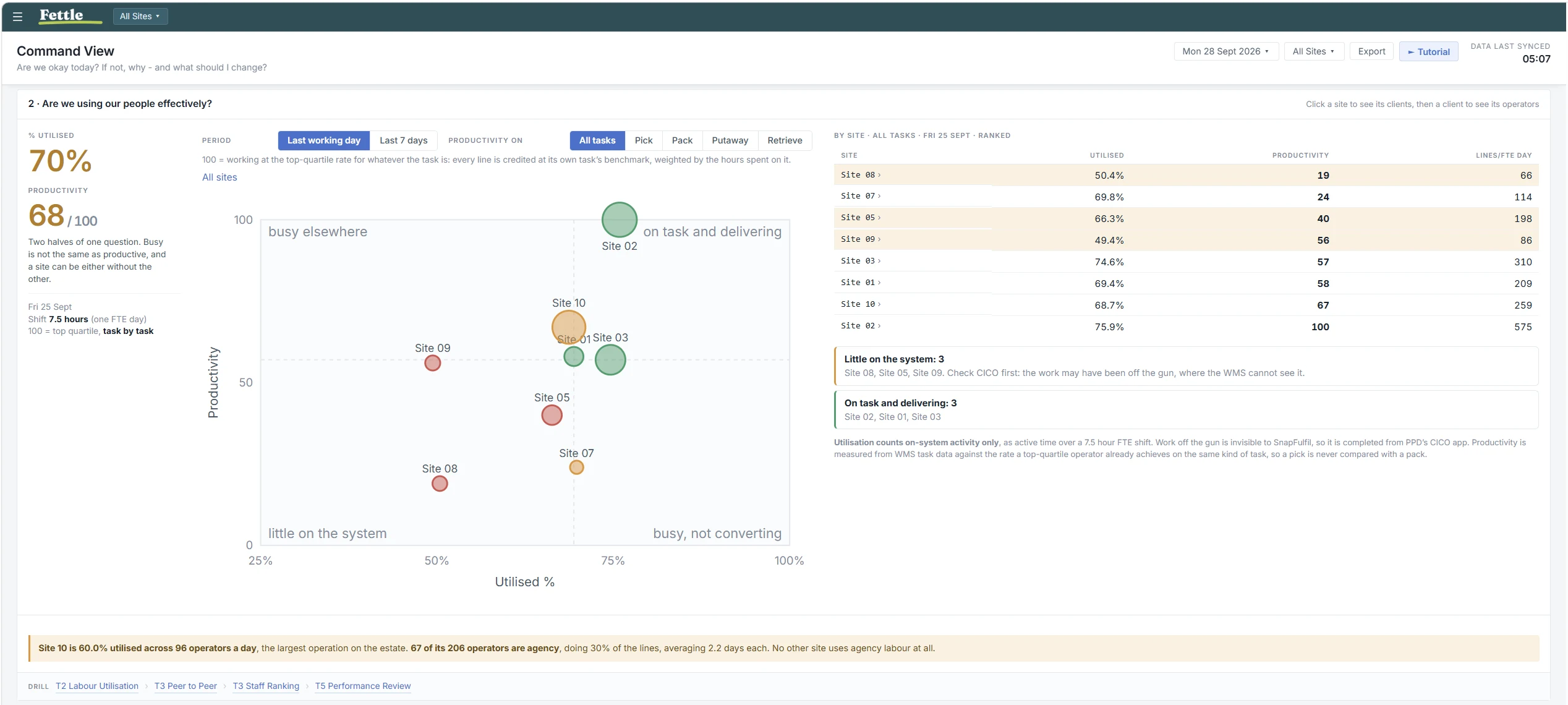
- Are we using our people effectively?
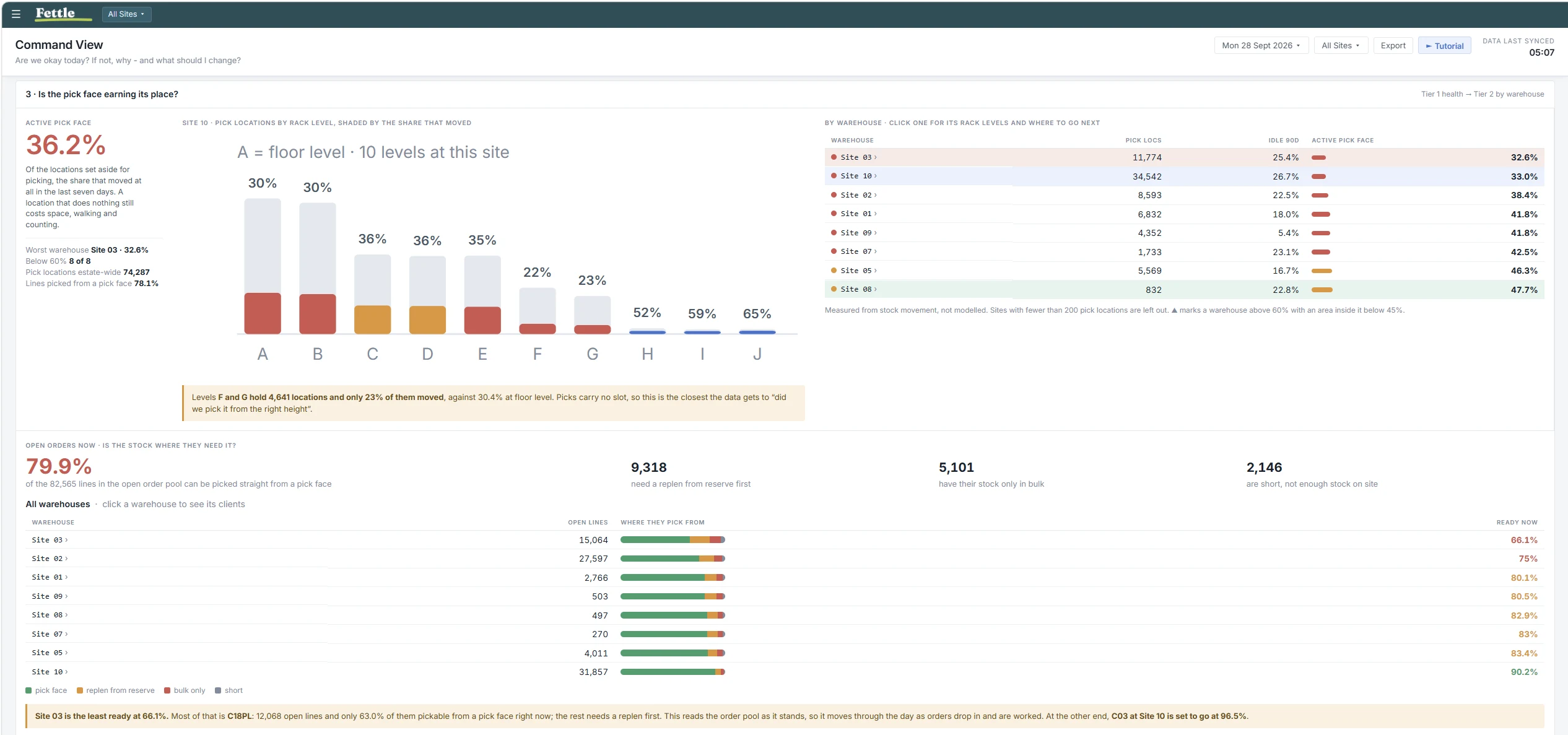
- Is the warehouse set up to work efficiently?
- Are we making money on the work we do?
Why is my warehouse busy and still behind?
Busy measures effort and behind measures orders. The gap between the two usually sits in work the systems can't see: walking to stock that isn't where it should be, pick lists that send everyone down the same aisle and hours spent on jobs the WMS never records. Fettle shows which of them is holding your warehouse back today.
Fettle works through it the way you do on the way in: are we okay today, if not why, and what should I change? Every warehouse gets run on four questions, each answered with evidence written in terms anybody on the floor can check.
On time and in full
On time and in full is whether the order left complete and when it was promised.
It answers the first question, will we deliver today's commitments? Put plainly: you ordered three products for tomorrow; did you get three products tomorrow? Fettle measures it by order type, which means the urgent work is judged against its own deadline rather than lost in the average.
Labour utilisation
Labour utilisation is the share of the paid hours spent on the work, with the off-system jobs the WMS never sees counted in.
Here it means people's time rather than floor space. Together with productivity it answers the second question, are we using our people effectively? In two warehouses we've worked in, utilisation read around 42 per cent on their own systems and 65 per cent once the off-system work was counted.
ONE SHIFT
Where the paid hours in a 7.5-hour shift go
Two bars show a 7.5-hour shift. On the systems alone, the tasks the WMS recorded fill around 42 per cent of it, about three hours ten minutes. With the off-system work counted, the bar reaches 65 per cent, about four hours 53 minutes. A shaded band from 85 to 90 per cent marks the realistic level, about six hours 23 minutes to six hours 45 minutes, at least 90 minutes further on.
Two warehouses we've worked in, measured on their own systems and then with the off-system work counted. The hours are those percentages applied to a 7.5-hour shift.
Productivity
Productivity is tasks an hour against what a reasonable operator does, rather than the best one.
Fettle compares people only with others doing the same job in the same zone, since dense racking and a wide aisle are different jobs and one odd order shouldn't make anybody look like a star. Where a route has an engineered standard, each pick run is measured against the time that route should take.
ONE TEAM, ONE SHIFT
The same work, divided three ways
Three bars for the same team and shift. WMS tasks only, over clocked hours, reads 42 per cent, which is low. All the work over clocked hours reads 65 per cent, which is right. All the work over first scan to last scan reads 75 per cent, which is high because paid hours drop out of the sum. A shaded band marks 85 to 90 per cent as realistic.
An example rather than a measurement, set to land where two warehouses we've worked in did.
Stock placement
Stock placement is whether the product sits where the work is, so people aren't walking for it.
It answers the third question, is the warehouse set up to work efficiently? Fettle looks at how often each product is picked, where it sits and how full the location is, which is how eight sets of brake pads turned up in a full pallet location after 223 days in a warehouse we've worked in.
AN ILLUSTRATION
Where the stock sits against how often it's picked
An illustration: a grid of pick locations shaded by how often each is picked, with the busiest nearest the start of the pick route. One location near the front is flagged: a full pallet location holding eight sets of brake pads, there for 223 days without anybody noticing.
An illustration of a pick-face map. The flagged location is a real finding from a parts warehouse we've worked in.
The fourth question, are we making money on the work we do, is the one a 3PL lives with. Fettle shows on time and in full client by client, so one struggling contract shows up as that contract rather than as the whole warehouse.
What needs attention today comes first
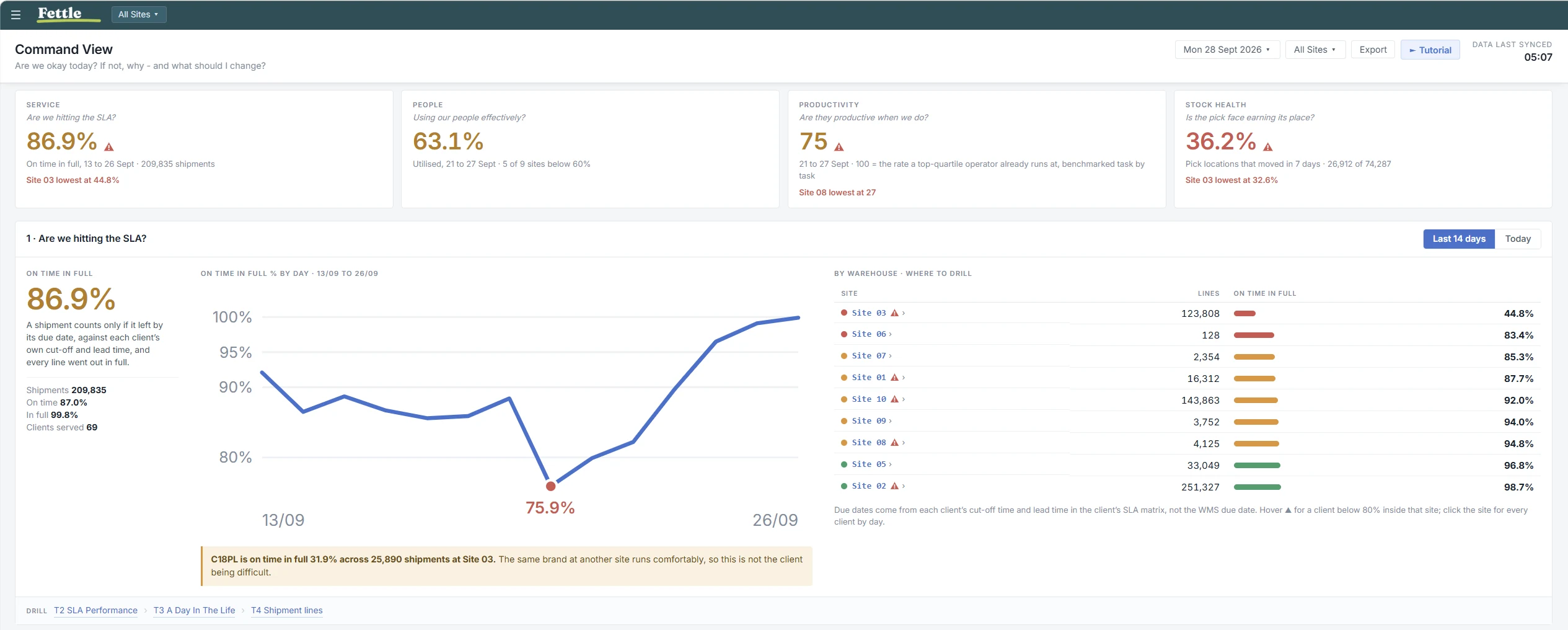
The command view sets out the priorities for your role and the way your operation runs, at warehouse, client or section level. Every number on it opens into the evidence underneath, down to the shift and the person it came from.
Managers we work with would rather be handed the exception than dig through reports for it, since the shift is better spent managing than sat at a screen.
Nothing is hidden, since the detail waits until you ask for it rather than arriving all at once. If you'd rather start from the detailed operational views you already know and come to the command view later, that works too. Fettle shows what matters and you decide what to do about it.
The command view, the screen that says what needs attention today, before anybody opens a dashboard.
-
Service
Will we deliver today's commitments?
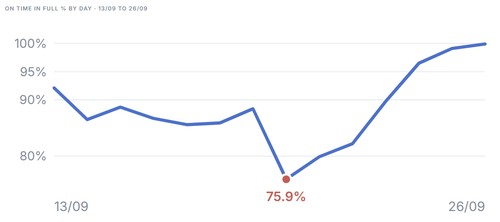
What Fettle flagged
C18PL is on time in full 31.9% across 25,890 shipments at Site 03. The same brand at another site runs comfortably, so this is not the client being difficult.
-
People
Are we using our people effectively?
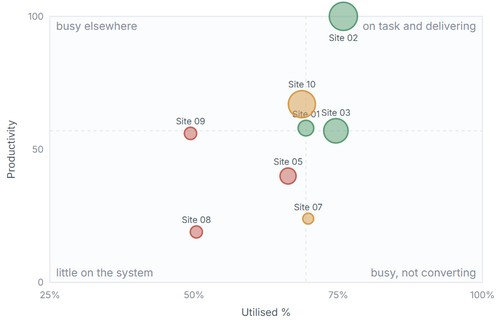
What Fettle flagged
Site 10 is 60.0% utilised across 96 operators a day, the largest operation on the estate. 67 of its 206 operators are agency, doing 30% of the lines, averaging 2.2 days each. No other site uses agency labour at all.
-
Stock health
Is the warehouse set up to work efficiently?
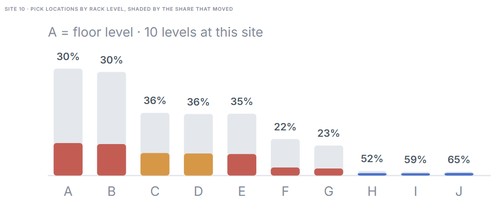
What Fettle flagged
Levels F and G hold 4,641 locations and only 23% of them moved, against 30.4% at floor level.
Will Fettle replace the people who run the warehouse?
No. Fettle takes away the hours spent collating numbers, so the facts arrive with the evidence underneath. What's left is judgement: which exception matters, what to change and when. Managers get judged on the quality of those decisions. A good manager adds more than the software can on its own.
Ask Albie
Albie answers questions about your operation in plain English. Ask it which zone lost the most time on last night's shift, or how many lines are still to pick for the next trailer: the answer comes back in one sentence, with the number and where it came from.
When the data can't answer the question, Albie says so plainly rather than reaching for the nearest number it does hold. It answers questions and nothing more: it doesn't make decisions, recommend actions or rank anybody.
AI is only as good as the data going into it, which is why Albie reads your data after it's been standardised and checked, never the raw feed from each system.
Ask Albie
-
Which zone lost the most time on last night's shift?
One sentence, with the number and where it came from.
-
How many lines are still to pick for the next trailer?
One sentence, with the number and where it came from.
- Answers in one sentence
- Says so when the data can't answer
- Never decides, recommends or ranks anybody
What it means for the people on the floor
Nobody on the floor wants to be judged by a system that can't see half of what they do. Supervisors log the work the WMS never records, such as replenishment, goods in, housekeeping and training, so an hour spent unloading a lorry stops looking like an hour stood still.
Operators see their own performance in an app: whether they're improving or slipping, measured against people doing the same job in the same zone. When there's overtime going, the app offers it to the people who can do that work, so the extra hours go to your own team before anybody rings the agency.
Will this be used to cut jobs?
Fettle shows where the paid hours go, including the work the systems never recorded, so the first thing it changes is how fairly people are measured. What you do with the time it finds is your call: cutting agency hours, covering peak without extra shifts or taking on more work with the team you have.
Which of these is you?
The demo is set up for the kind of warehouse you run, so pick the one closest to yours.
We buy and sell
The demo starts with where your people's time goes and finishes on what each order line costs you to pickWe make and sell
A late pick can stop the line, so the demo starts with the orders the plant is waiting on, measured against their own deadline, then moves to where the stock sits and how the labour is usedWe run it for somebody else
You're paid contract by contract, so the demo starts with on time and in full for each client, then how your people's time is used and what both mean for each contract's margin
If none of them quite fits, book one anyway and tell us how your warehouse runs.